At just 16 years old, Chrissy Steltz survived a devastating shotgun accident that destroyed much of her face and left her permanently blind. Doctors were astonished that she survived. But what happened over the following 11 years became an extraordinary story of courage, determination, love, motherhood, and the medical specialists who helped restore her appearance.
For most teenagers, spring break is a time for laughter, friendship, and unforgettable memories. But for Chrissy Steltz, spring break in 1999 became the moment that changed her life forever.
She was just 16 years old, living in Portland, Oregon, when an ordinary gathering with friends turned into a horrifying accident.
A teenage friend was handling a 12-gauge shotgun inside her apartment. According to reports, he believed the weapon was unloaded.
It wasn’t.
The gun suddenly discharged from approximately five feet away, striking Chrissy directly in the face.
In a fraction of a second, the teenager’s life was transformed.
The blast destroyed her nose, severely damaged the central portion of her face, and devastated her eye sockets. Her injuries left her completely blind.
What followed was a medical emergency so severe that even experienced surgeons struggled to believe she could survive.
A Fight for Survival That Doctors Would Never Forget
Chrissy was rushed to the hospital, where medical teams worked desperately to save her life.
Her injuries were catastrophic.
Surgeons faced the enormous challenge of treating extensive damage to her facial bones, soft tissues, and surrounding structures while keeping her alive.
She remained in a medically induced coma for approximately six weeks.
During that time, her family faced an agonizing uncertainty. No one could guarantee that she would survive, much less recover enough to return to anything resembling an ordinary life.
Dr. Eric Dierks, the surgeon who helped treat her, later described the extraordinary severity of her injuries. He reportedly said he had never encountered a patient with such devastating facial trauma who had survived.
Reports also indicated that medical imaging continued to show tiny fragments lodged in her brain long after the accident.
Chrissy underwent more than a dozen surgical procedures as doctors worked to repair the damage and stabilize her condition.
But surviving was only the beginning.
When she eventually awakened, she faced a reality that would have overwhelmed many adults.
She could no longer see.
Much of the face she had known since childhood was gone.
And the life she had imagined for herself would have to be rebuilt almost entirely.
The Teenage Girl Who Refused to Give Up
One of the most remarkable parts of Chrissy’s story is what she did after leaving the hospital.
Despite everything she had endured, she was determined to continue her education.
She returned to high school.
Imagine the courage that required.
She was still a teenager, navigating an environment where appearance, friendships, and acceptance can feel enormously important.
While other students worried about examinations, relationships, and graduation, Chrissy was learning how to live without sight and adjust to profound physical changes.
Yet she refused to let the accident take away her future.
She learned Braille so she could continue reading. She trained to use a white cane, developing the skills necessary to navigate the world independently.
And she continued studying.
When her senior prom arrived, Chrissy made another remarkable decision.
She attended.
Wearing a white mask over the injured portion of her face, she joined her classmates for one of the most memorable celebrations of their teenage years.
It was an act of extraordinary confidence.
She could have stayed home, avoiding the questions, stares, and attention that might have followed her.
Instead, she chose to participate in life.
She eventually graduated with her class, reportedly earning straight A’s.
Her accomplishments were not simply evidence of academic ability. They reflected her determination to remain an active participant in her own future.
The accident had changed her appearance and taken her eyesight, but it had not taken her ambition.
Finding Love After an Unimaginable Tragedy
As Chrissy adjusted to blindness, she attended classes designed to help people with visual impairments develop independence and practical skills.
It was there that she met someone who would become one of the most important people in her life.
His name was Geoffrey Dilger.
Like Chrissy, Geoffrey had lost his sight when he was 16.
Their circumstances were different, but they shared an understanding of what it meant to have life change suddenly during adolescence.
They knew the frustration of adjusting to blindness.
They understood the importance of independence.
And they recognized that losing sight did not mean losing the possibility of happiness, love, or a meaningful future.
Their friendship eventually developed into a romantic relationship.
They fell in love and married.
For Chrissy, who had survived an accident that nearly killed her, building a marriage represented another chapter in a life she once might not have believed possible.
Then came another extraordinary milestone.
In 2009, the couple welcomed a baby boy, whom they named Geoffrey.
Becoming a mother brought Chrissy a new sense of purpose and joy.
She had survived a devastating injury, completed her education, learned to navigate life without vision, and found a loving partner.
Now she had a son.
But there was still one part of her journey that remained unfinished.
Eleven Years Behind a Black Mask
For approximately 11 years after the accident, Chrissy lived without the central facial features that most people take for granted.
When she went out in public, she often covered the injured area with a black sleep shade.
The covering offered a practical way to conceal the visible effects of her injuries, but it also served as a constant reminder of the accident.
Everyday activities could bring unwanted attention.
Meeting strangers, visiting stores, attending appointments, or simply walking through public spaces could mean encountering people who did not know how to respond to her appearance.
Chrissy had already demonstrated remarkable resilience.
She had a husband who loved her, a child she adored, and a life she had worked hard to build.
But she still hoped for a facial prosthesis that could restore a more familiar appearance.
For years, that possibility remained out of reach.
Reconstructing the central portion of a face after such extensive trauma is extraordinarily complex. Conventional surgery cannot always recreate the missing structures, particularly when large amounts of bone and soft tissue have been destroyed.
A custom-made facial prosthesis offered another possibility.
However, the treatment required specialized expertise, careful planning, and significant resources.
Insurance coverage was another obstacle.
According to accounts of her case, insurers classified the proposed prosthetic treatment as cosmetic rather than medically necessary.
That classification made obtaining the treatment even more difficult.
But a team of specialists believed Chrissy deserved the opportunity.
And they decided to help.
The Medical Team That Helped Give Chrissy a New Face
In February 2010, Dr. Eric Dierks began a crucial stage of Chrissy’s transformation.
He surgically placed eight titanium implants into her facial bones.
These implants were designed to provide secure attachment points for a custom facial prosthesis.
Unlike a traditional mask, which simply rests against the skin, an implant-retained prosthesis can be attached using specialized magnetic connections.
This allows the prosthesis to remain securely positioned while also being removable for cleaning and maintenance.
The next stage required a different kind of expertise.
Prosthodontist Dr. Larry Over and prosthetist David Trainer worked to create a realistic silicone replacement for the missing portion of Chrissy’s face.
Their task was not simply to manufacture a medical device.
They needed to reproduce facial features that looked natural, fit her remaining anatomy, and helped restore the appearance she had lost as a teenager.
Using a cast and careful measurements, the specialists sculpted a custom prosthesis.
The work demanded extraordinary attention to detail.
The shape of the nose, the contours surrounding the eyes, the texture of the silicone, and the coloring of the artificial skin all needed to work together.
One especially meaningful detail was the color of her eyes.
Before the accident, Chrissy had light blue eyes.
The team fitted the prosthesis with acrylic eyes designed to recreate that color.
For someone who had lost her eyesight and much of her face at 16, this detail carried emotional significance.
It was a connection to the person she remembered being before the accident.
A Face Held in Place by Magnets
The finished prosthesis was a remarkable example of how modern medicine, engineering, and artistic craftsmanship can work together.
It was made from silicone, a flexible material that can be carefully colored and shaped to resemble human skin.
The facial replacement incorporated realistic artificial eyes and reconstructed the central features missing since the accident.
Small magnets connected the prosthesis to the titanium implants placed in Chrissy’s facial bones.
This design allowed her to attach and remove it without undergoing additional surgery every time it needed cleaning.
The prosthesis could be taken off and washed with ordinary soap and water.
Although it did not restore her eyesight or reverse the underlying injuries, it offered something profoundly important: a more natural facial appearance.
The medical team also made an extraordinary contribution.
According to reports, the specialists donated their professional time to help make the procedure possible.
Their generosity helped overcome the financial barriers that had prevented Chrissy from receiving the treatment.
After more than a decade of waiting, the prosthesis was finally ready.
The Moment Everything Changed
Chrissy was 27 years old when she received her new facial prosthesis.
Eleven years had passed since the accident.
During those years, she had endured countless medical procedures, adjusted to blindness, finished high school, fallen in love, married, and become a mother.
Now she was experiencing another milestone.
For the first time since she was 16, she could go into public with a face that more closely resembled the one she remembered.
The prosthesis did not erase the accident.
It could not restore her vision.
And it did not undo the physical and emotional challenges she had experienced.
But it gave her something she had wanted for years.
Speaking about the transformation, Chrissy expressed her happiness in a simple sentence:
“I feel like a regular person again.”
Those words captured the emotional importance of the procedure.
Her worth had never depended on her appearance. She had already demonstrated extraordinary strength, intelligence, and love throughout the years without the prosthesis.
But having the choice to present herself differently in public mattered deeply to her.
It gave her greater comfort and confidence.
And perhaps most importantly, it allowed her to imagine a different experience for her young son.
A Mother’s Wish for Her Son
When Chrissy received the prosthesis, her son Geoffrey was still very young.
She spoke about wanting him to grow up knowing her with a face, like everybody else.
It was a simple wish, but one filled with meaning.
Chrissy had spent much of her adult life adapting to circumstances she never chose.
She had learned to live without eyesight, overcome enormous medical challenges, and navigate public spaces while covering the injured portion of her face.
But motherhood introduced another perspective.
She wanted to be able to hold her child, care for him, and participate in family life without the additional burden of unwanted attention surrounding her facial injuries.
The prosthesis gave her another option.
For the medical specialists involved, the procedure represented an important technical achievement.
For Chrissy, it was deeply personal.
It was about family, confidence, and the freedom to move through everyday life in a way that felt more comfortable.
More Than a Medical Miracle
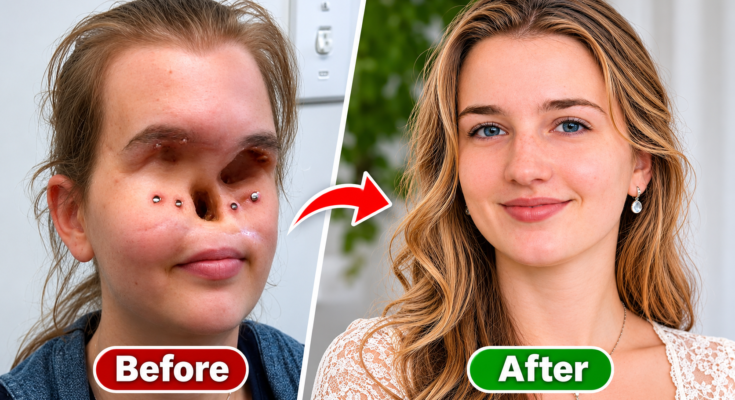
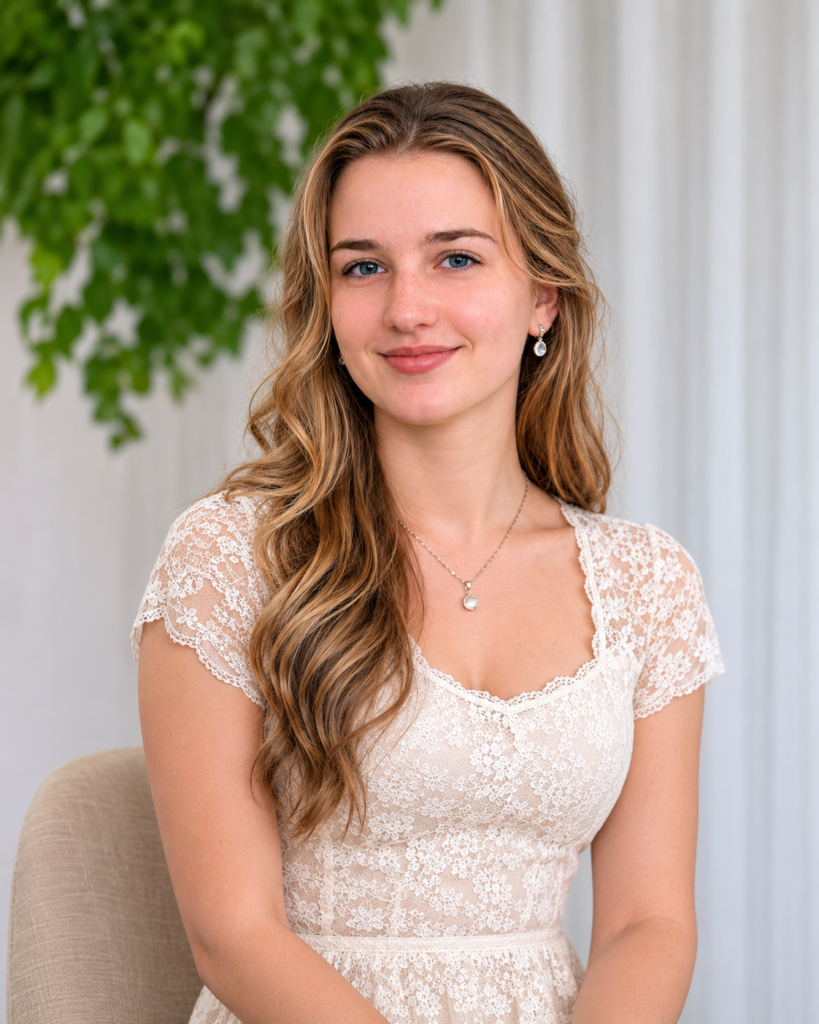
Chrissy Steltz’s story is often remembered because of the dramatic before-and-after photographs showing the effects of her injury and the remarkable prosthesis created years later.
But focusing only on those photographs misses much of what makes her experience extraordinary.
Her story is not simply about a woman who lost her face and received a new one.
It is about a teenager who survived an accident that doctors considered almost unsurvivable.
It is about a student who returned to school despite permanent blindness and graduated with excellent grades.
It is about a young woman who attended her senior prom even when she knew her appearance would attract attention.
It is about two people who understood the challenges of blindness and found love together.
It is about a mother determined to build a happy life for her child.
And it is about medical professionals who recognized that restoring someone’s appearance can have profound psychological and social importance, even when a procedure cannot reverse the original injury.
Chrissy’s journey also raises important questions about access to reconstructive and prosthetic care.
For people who have experienced severe facial trauma, a prosthesis can serve purposes far beyond appearance alone.
It may help with confidence, social participation, emotional well-being, and personal identity.
Classifying such treatment as merely cosmetic can overlook the enormous impact that facial differences may have on a person’s daily experiences.
The specialists who helped Chrissy demonstrated how compassionate medical care can change someone’s life.
Their work combined surgical expertise, prosthetic engineering, artistic precision, and generosity.
Together, they gave her an opportunity that had seemed impossible for more than a decade.
The Strength That Was There All Along
There is one final detail about Chrissy’s story that deserves to be remembered.
Her new face did not create her courage.
That courage had already been there.
It was present when she woke from a six-week coma and began confronting the consequences of the accident.
It was there when she learned Braille.
It was there when she returned to high school.
It was there when she attended her senior prom wearing a mask.
It was there when she fell in love, married, and welcomed her son into the world.
By the time she received her prosthesis in 2010, Chrissy had already achieved things that many people would consider extraordinary.
The prosthesis did not make her a whole person.
She had always been one.
What it did was help her reclaim a part of her appearance that she had missed for 11 years.
And that distinction makes her story even more powerful.
At 16, Chrissy Steltz survived an accident that nearly ended her life. At 27, she received a remarkable facial prosthesis that helped her begin another chapter. But throughout those 11 years, she never stopped building a life filled with determination, love, and hope.
Her journey remains a moving reminder that while tragedy can change the course of a person’s life, it does not have to define everything that follows.
Sometimes the greatest transformation is not what medical science can restore on the outside.
It is the remarkable life a person continues to build along the way.