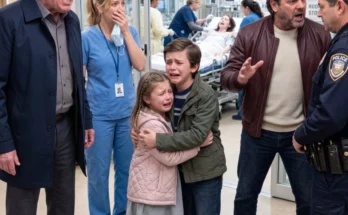
“Mommy… please don’t let Daddy lock me away again.”
I froze beside the small white casket.
For two days, I had been trying to accept the unbearable truth: that my six-year-old daughter, Sophia, was gone.
Fernando, my ex-husband, had called to tell me she had experienced a sudden, fatal respiratory emergency while sleeping.
They wouldn’t let me see her at the hospital.
They refused to provide her complete medical records.
When I requested an independent examination, his mother, Claudia, publicly accused me of trying to turn our daughter’s funeral into “another scene from a bitter, resentful ex-wife.”
But that tiny voice had just come from inside the casket.
“Sophia…?” I whispered, my pulse pounding against my ribs.
The little girl’s eyelids moved.
I quickly opened the inner lid of the casket, the air disappearing from my lungs.
She was pale, covered in cold sweat, and breathing very faintly.
As I reached inside to lift her up, my hands touched something firm: her small wrists had been secured beneath the casket lining with thick plastic ties fastened with tiny padlocks.
“Mommy… I’m so cold.”
I didn’t cry.
I couldn’t.
Fear immediately transformed into a cold, frigh.ten.ing clarity.
Three years earlier, Fernando had received sole custody of Sophia after presenting a carefully organized case against me.
Using my career as a Medical Corps Colonel in the U.S.
Army, he presented questionable psychological evaluations, character witnesses, and testimony from his mother to portray me as an unstable,
frequently absent mother.
I challenged every ruling, but the family court eventually gave him full control.
Then came the explanations.
Sophia was “too sick” for visits. She “didn’t want to see me.” Her therapist supposedly recommended “emotional distance.” Natalia, Fernando’s new partner, answered my calls with dismissive authority, behaving as though she were the mother now.
Two days ago, Fernando informed me of Sophia’s de:ath and arranged an expedited cremation with an urgency that immediately felt deeply wrong.
Now I understood why.
I examined Sophia’s white dress and noticed several fresh marks on her inner arm.
Medication.
“Who did this to you, baby?” I whispered, my hands shaking.
“Daddy said it was sleeping medicine…” Sophia murmured softly.
“Grandma held me still… Natalia locked the door.”
I searched quickly beneath the casket’s satin padding until my fingers finally touched a small key taped underneath.
I released the plastic ties, gathered my daughter into my arms, and lifted her out.
Footsteps suddenly echoed down the funeral home hallway.
“Valerie?” Fernando’s voice called as he rounded the corner.
“What are you doing?!”
I carried Sophia into the adjoining preparation room, closed the heavy door, and quickly secured the deadbolt.
Taking out my phone, I dialed 911.
“This is Colonel Valerie Serrano.
My six-year-old daughter was declared dead forty-eight hours ago.
She is alive.
She appears heavily sedated, was restrained, and placed inside a casket scheduled for immediate cremation.
I need emergency medical assistance and police officers at San Gabriel Funeral Home immediately.”
Outside the door, Fernando began pounding repeatedly against the wood.
“Open this door right now!”
Then Claudia’s voice rang out from the hallway,
loud enough for the emergency dispatcher to hear clearly: “Nobody was supposed to open that casket before the furnace!”
Sophia buried her face against my uniform jacket.
“Mommy… Daddy said if I slept long enough, he wouldn’t have to give back Grandpa’s money.”
A terrible chill moved through me.
My father, a retired Army General, had established a substantial irrevocable trust fund for Sophia—a fortune intended to protect her education and future.
And Fernando was currently her legal trustee.
Sirens began sounding in the distance.
I believed I had just discovered the worst nightmare my ex-husband could possibly create.
I had no idea that within hours, police would search his home and discover something that would transform this disturbing incident into an even deeper mystery.
Sophia reached the military medical center alive, but the attending doctors were direct: her system contained a d@ngerous combination of prescription sedatives, with clear signs suggesting repeated, substantial dosing over several days.
While the medical team worked to stabilize her, state police secured the funeral home and detained Fernando, Claudia, and Natalia for questioning.
They immediately gave conflicting accounts.
Fernando claimed it had been a devastating “medical misdiagnosis” by the attending clinic.
Claudia insisted the wrist restraints had been used by the transport team to “keep the body secure.”
Natalia stated under oath that she had never witnessed Sophia being restrained.
Their explanation quickly unraveled when a nurse discovered a high-strength prescription patch attached to Sophia’s upper back.
The prescription batch number was completely traceable.
An hour later, a judge approved an emergency search warrant for Fernando’s residence.
I was standing outside the pediatric ICU window when the lead detective approached me.
“Colonel Serrano, there’s something you need to see.”
He handed me a tablet showing evidence photographs taken inside Fernando’s basement.
Behind a concealed panel, officers had discovered a windowless, insulated room containing a child’s cot, internal surveillance cameras, and a reinforced door that could only be locked from the outside.
On a nearby shelf were matching prescription bottles of the same sedatives detected in Sophia’s system.
But there was more.
On a small desk inside the room were school notebooks belonging to Maya Beltran—a six-year-old girl who had been reported missing three months earlier.
I immediately recognized the name from national news.
Her father, Marcus Beltran, was a prominent defense contractor who had recently filed a major fr@ud lawsuit against Fernando’s construction company.
“Was Maya staying in that room?” I asked, my stomach tightening.
“Forensics recovered hair, clothing, and a school ID belonging to Maya,” the detective confirmed quietly.
“We also recovered altered travel documents apparently intended to move her out of the country using another identity.”
My father, retired General Arturo Serrano, walked up behind me.
His usual composed military demeanor was gone; his face looked pale, burdened by the painful realization of what his wealth had exposed his granddaughter to.
“It was the trust fund,” my father said quietly.
“Fernando was facing complete financial collapse.
Under the terms of the trust, if Sophia p@ssed away while he remained her sole legal guardian, he could petition for temporary control of the assets during probate.”
“Temporary control?” I asked.
“Enough to access millions, settle his creditors, and leave the country before anyone thoroughly reviewed the accounts. But he needed a cooperative doctor to certify a natural de:ath.”
Law enforcement had already detained the physician who signed Sophia’s death certificate: Dr. Sergio Reyes, Natalia’s brother.
Records showed he had never even entered the room to personally examine Sophia before issuing the document.
Additional forensic evidence showed that weeks earlier, Fernando had obtained certified copies of the trust agreement, Sophia’s life insurance policies, and consultation notes explaining how to begin expedited probate proceedings involving a dece:ased minor.
Everything appeared carefully prepared.
Then, shortly before dawn, an investigator rushed down the hallway toward us.
“We found Maya Beltran.”
I stood immediately.
“Is she alive?”
The officer paused.
“Yes.
State troopers just located her at a rented property two hours away.
She’s safe.
And the caretaker staying with her just admitted that Fernando wasn’t the person actually giving the instructions.”
I looked through the glass at Sophia, who was sleeping beneath the steady rhythm of the heart monitors.
If Fernando wasn’t the person directing this entire operation, then someone else within that family had been planning it long before now.
And the name the caretaker gave investigators was the last person I expected.
The woman responsible for watching Maya was a fifty-eight-year-old former private nurse named Grace.
State troopers searched the secluded property, finding Maya weak and heavily medicated, but stable.
When investigators asked Grace who had been paying her salary, she didn’t name Fernando.
She named Claudia.
Fernando’s mother.
For a moment, I could hardly comprehend it.
Claudia had always treated me cruelly.
During our divorce, she testified that I “preferred a military uniform to being a real mother,” repeatedly interfered with my visitation rights, and closely monitored my communications with Sophia.
But organizing an abduction scheme,
endangering children, and arranging the funeral of her own living granddaughter represented a level of cru:elty I had never imagined.
Maya had been their primary source of leverage.
When her father, Marcus, uncovered Fernando’s multi-million-dollar corporate embezzlement scheme, Claudia arranged for Maya to disappear from a dance studio playground to pressure Marcus into dropping the criminal case.
When Marcus refused to surrender to their demands,
Claudia changed her plan: keep Maya isolated, obtain fraudulent adoption documents, and secretly move her through an illegal international network.
The transfer had only been delayed because their offshore contact disappeared with part of the payment.
Sophia, however, didn’t need to be taken anywhere.
They already had complete legal custody of her.
The trust fund my father established contained an emergency clause allowing a legal guardian temporary management of accumulated dividends to cover emergency medical or administrative expenses following a beneficiary’s death.
It wasn’t complete ownership, but it gave Fernando legal access to millions in liquid assets—enough to settle his debts and disappear.
Claudia knew I was weeks away from securing a court date to challenge their custody arrangement.
If I regained custody of Sophia, their access to the trust would be permanently severed.
So they decided my daughter had to “d!e.”
Dr. Sergio Reyes issued the fraudulent de:ath certificate.
Natalia obtained the unauthorized sedatives.
Fernando gave Sophia the medication over several days.
But their plan encountered a problem: Sophia survived the d@ngerous amount.
Instead of dy!ng, she slipped into a deep, unresponsive state.
When Reyes checked her condition at the house, he detected a faint, slow pulse and warned them that she required emergency medical care immediately.
Claudia refused.
“If she wakes up in a hospital and talks, we all go to federal prison,” Claudia told them.
That statement was captured on a recording.
Fernando had unknowingly recorded the entire conversation through a cloud-connected security camera installed in the dining room.
Federal agents recovered the audio file.
They also recovered another recording where Natalia could be heard pan!cking: “This has gone too far! I agreed to forge paper trails, not hurt a child!”
Claudia replied coldly: “You’re already involved in the kidnapping. If we fall, you fall with us.”
Fernando’s voice was barely audible in the recording, until he eventually said: “The cremation is scheduled for eight in the morning.
Once it’s finished, there’s nothing left to examine.”
When the prosecutor played that recording for me in the office, something inside me seemed to collapse.
It wasn’t only anger—it was the de.vas.ta.ting realization that the man I had once married had remained silent while his mother planned something unthinkable involving our child.
I demanded to speak with him in the interrogation holding room.
My legal team advised me against it, but I entered anyway.
Fernando sat at a metal table, without his expensive suit, his tie, or his usual confidence.
He looked defeated, as though he had aged ten years overnight.
“Valerie…” he whispered.
“I never wanted it to go this far.”
I sat across from him, keeping my voice remarkably quiet.
“You secured our six-year-old daughter inside a sealed casket.”
“My mother told me she would never wake up…” he stammered.
“She said it was temporary—”
“She was scheduled for cremation at eight in the morning, Fernando.”
He covered his face with his hands, crying.
“I was desperate! I owed more than twelve million dollars! Beltran was going to send me to federal prison! The banks froze my accounts! My mother said if we accessed the trust for only a few months,
we could fix the books and then…”
“And then what?” I asked, leaning closer.
“Say it.”
“Then we were going to claim the de:ath certificate was an administrative error…”
I stared at him.
The explanation was almost impossible to comprehend.
“Sophia told me she stayed completely still while you gave her the medicine,” I said softly.
“She told me she didn’t cry because you promised that if she was a good girl, she would wake up somewhere beautiful and new.”
Fernando began crying uncontrollably.
“I love her, Valerie! I love my daughter!”
“Don’t say those words,” I replied, my voice dropping so low that he immediately became silent.
“A father who loves his daughter doesn’t repeatedly give her d@ngerous medication. He doesn’t isolate her inside a hidden room. He doesn’t teach her to fear her mother. And he doesn’t place her inside a casket while she is still alive.”
He sank into his chair, unable to look at me.
“For three years, you called me unfit,” I continued.
“You convinced a family court judge that my military service made me unsuitable to raise my child.
Every time I requested visitation, you invented illnesses and emotional emergencies.
And while I was at home falling apart, believing my daughter wanted nothing to do with me, you were teaching her to become afraid of her own mother.”
The police investigation eventually uncovered a deeply troubling pattern.
Whenever Sophia asked about me, Claudia isolated her in the basement room for hours.
Whenever I called for scheduled video chats, they gave her medication and told me she was “too sick” to speak.
The court-appointed child therapist who repeatedly recommended suspending my visitation rights was also indicted; financial records showed she had accepted more than $150,000 in improper payments from Fernando’s company to submit misleading psychological evaluations.
The legal system hadn’t failed me because of one isolated mistake; it had been deliberately manipulated through dishonest medical records, compromised evaluations, and people willing to misuse their authority.
Sophia spent two weeks receiving specialized pediatric care.
For the first few days, she barely spoke.
She sometimes woke frigh.ten.ed during the night, asking whether the white box was still locked and becoming anxious whenever the room grew dark.
One night, a pediatric nurse entered to adjust her IV line, and Sophia became terrified, begging not to receive the “sleeping medicine.”
I hurried to her bedside, gently holding her face in my hands.
“Look at me, Sophia.
Look at Mommy.
Nobody is ever going to give you medicine without explaining it to you. Nobody is ever going to lock you away. Nobody is ever taking you away from me again.”
“Not even Grandma?” she whispered through her tears.
“Not ever again.”
“Not even Daddy?”
That question broke my heart.
“Not even Daddy.”
Sophia looked at me for a long moment, then rested her head against my chest.
“Then you really are my real mommy.”
Maya Beltran was also reunited with her father.
Her recovery required considerable time after months of isolation, but with professional support and her father’s devotion, she gradually began to heal.
Natalia agreed to cooperate with prosecutors in exchange for a reduced sentence,
providing details about the entire financial and abduction operation.
Dr. Sergio Reyes lost his medical license and received a thirty-year sentence for charges connected to the attempt on Sophia’s life and falsification of medical records.
The compromised family court therapist was convicted on fraud and bribery charges.
Fernando, Claudia, and their co-conspirators were convicted on federal charges involving attempted murder, kidnapping, child mistreatment, and financial fraud.
Claudia received life imprisonment without parole.
Fernando was sentenced to forty-five years in federal prison.
The day the family court judge permanently restored my full parental rights, I felt no real sense of victory.
I only felt an overwhelming, profound exhaustion.
The judge asked to address me directly before closing the case.
“Colonel Serrano, no court ruling can ever undo the terrible tr@uma inflicted upon you and your daughter by failures within this system.”
“No, Your Honor.
It can’t,” I replied firmly.
“But we can make sure the people who enabled it never do it again.”
My father and I completely restructured Sophia’s trust.
We placed it under strict, multi-signature judicial oversight, ensuring that no single individual could ever control the capital.
A significant portion of the funds was redirected to establish a nonprofit foundation dedicated to funding independent legal and psychological representation for children involved in high-conflict custody cases where serious safety concerns had been raised.
Sophia’s recovery wasn’t immediate.
It required months of therapy, patient love, and constant reassurance.
One afternoon in late spring, I took her to a nearby park.
The sun was shining, and the air felt crisp.
She ran across the grass, stumbled, stood back up, and laughed aloud.
Something so ordinary felt like an absolute miracle.
My father sat beside me on a park bench, his eyes moist as he watched her play.
“I thought that trust fund was going to secure her future,” he said quietly.
“Money doesn’t protect anyone by itself, Dad,” I replied, taking his hand.
“We protect her.”
Sophia came running toward us, her cheeks flushed from playing.
She reached up, wrapping her small arms around my neck.
“Are you cold, baby?” I asked, holding her close.
She shook her head, smiling brightly at me.
“Not anymore, Mommy.”
Justice wasn’t simply about seeing the guilty face consequences.
It wasn’t about the money or the headlines.
Justice was watching my daughter sleep peacefully with her bedroom door wide open.
Justice was watching her slowly learn that her mother’s embrace was a place of safety, knowing that she could finally sleep without being afraid of the dark again.